Anabolic Insights vs Function Health: Lab Panels and Price per Marker Compared (2026)
Function Health vs Anabolic Insights: a $365 yearly membership vs pay-per-test panels, compared on price per marker, retests, turnaround and lab options.
Educational content · Not medical advice · Provider evaluation required for any treatment

Disclosure: Anabolic Insights publishes this page and has a financial interest in it. Everything about Function Health comes from its public website and FAQ, checked on October 11, 2026.
Function Health is the better fit if you want one yearly membership that covers a broad baseline panel, a built-in mid-year retest, written clinician summaries and add-ons like MRI. Anabolic Insights is the better fit if you want to pay per test with no membership, retest hormones whenever you need to, and choose between Quest, LabCorp and BioReference.
On price per marker the two land close together, roughly $2 to $3 per result for most options. The bigger difference is what gets retested and when.
The short answer
- Function Health: $365 a year ($1 a day). It includes "100+ tests" at your annual visit and "60+ tests 3-6 months later," which Function markets as "160+ lab tests annually." Draws are at Quest, or at home in select areas.
- Anabolic Insights: no membership to order labs. At Quest, the Basic Panel is $95 (75 biomarkers), the Complete Men's Panel is $239 (85) and the Advanced Men's Panel+ is $350 (123). Single tests start at $7.
- Hormones: on Function's public test list, testosterone, estradiol, SHBG, LH, FSH and PSA are not tagged "tested twice a year." With us you can recheck them any time, for example free and total testosterone for $18.
- Medications: Function says it doesn't offer medical treatment. We connect you with licensed providers who review every medication request, including a $99/month TRT membership in 14 states.
Anabolic Insights vs Function Health at a glance
| Anabolic Insights | Function Health | |
|---|---|---|
| Price | Pay per panel or test, no membership. Panels $95 to $350 at Quest | $365 a year. Fine print calls it a first-year price; membership renews at the then-current price |
| What's included | The panel or tests you pick: 75, 85 or 123 biomarkers per men's panel at Quest | 100+ tests at the annual visit plus a 60+ test mid-year retest |
| Single tests without joining | Yes, from $7 (CBC or CMP at Quest) | No. Add-on tests and re-tests are sold at a "member-only cost" that isn't published on its public site |
| Lab type | Venous draw at a Quest, LabCorp or BioReference patient service center | Venous draw at a Quest patient service center, or an at-home draw in select areas (price not published) |
| Turnaround | Typically 7–14 days; single hormone tests about 3 days | First results "start arriving within 48 hours"; its at-home draw page says results are ready "around 2 weeks" after the appointment |
| Provider review | A licensed provider orders every panel. Results go to your dashboard for education. A licensed provider reviews every medication request | "Clinicians review every result and flag issues," with a clinician's written summary and a call for critical results |
| Medications | Yes, prescribed only if a licensed provider decides it's appropriate | No. Function says it does not offer medical treatment |
| Imaging and add-ons | None | Annual MRI $899 for members, heart CT $349, lungs CT $399; Galleri and other add-ons (prices not published) |
| Upload outside lab PDFs | Yes, free for LabCorp and most Quest PDFs | Yes |
| Protocol overlays on charts | Yes | Not described on its public site |
| Wearables | Yes, with a $15/month membership | Yes, through connected apps |
| HSA/FSA | Itemized receipts may help you substantiate expenses with your plan | Says it's HSA/FSA eligible and provides an itemized receipt |
| Refunds and cancellation | No membership needed for labs | Cancel any time, no pauses, and "no refunds for prior payments" |
Sources: Function pricing, Function FAQ, What Function tests, Function imaging, Anabolic Insights lab panels, individual tests. Checked October 11, 2026.
Price per marker, worked out
Price per marker is price divided by results. It's a rough guide, not a verdict, because every company counts biomarkers differently. A CBC with differential can count as one test or as 15-plus results. Ratios and calculated values (like LDL, eGFR or a calculated free testosterone) may or may not be counted. Function's public list includes 20 urinalysis items and 15 values it labels "calculation derived from lab tests." Our counts also include CBC and CMP components.
Here is the math, with each assumption stated:
| Option | Price | Results counted | Price per result |
|---|---|---|---|
| Function, using its "160+ lab tests annually" claim | $365 | 160 | $2.28 |
| Function, counting its public list (119 + 62 retested) | $365 | 181 | $2.02 |
| Function, if you skip the mid-year retest ("100+") | $365 | 100 | $3.65 |
| Anabolic Insights Basic Panel, Quest | $95 | 75 | $1.27 |
| Anabolic Insights Complete Men's Panel, Quest | $239 | 85 | $2.81 |
| Anabolic Insights Advanced Men's Panel+, Quest | $350 | 123 | $2.85 |
| Advanced Men's Panel+ now, Basic Panel six months later | $445 | 198 | $2.25 |
To build the "public list" row, we counted every item Function marks "Included in membership" on its What we test page (119 unique items) and every item tagged "2x, tested twice a year" (62). Function's own marketing numbers are "100+" and "60+," so its real counts may differ slightly from its public page.
So per result, Function's membership and our larger panels are close, and our Basic Panel is the cheapest per marker. A count tells you less than the list does. Before you buy, open each panel's test list and check that the markers you care about are on it.
What gets retested matters more than the count
Function's mid-year retest is built in, which is a real advantage. But look at which markers carry the "tested twice a year" tag on its public list:
- Retested: standard lipids, hs-CRP, glucose, A1c, insulin, a CBC with hematocrit, kidney and liver markers, electrolytes and a 20-item urinalysis.
- Not tagged for retesting: testosterone (total and free), estradiol, SHBG, LH, FSH, PSA, ApoB, Lp(a), TSH, ferritin and vitamin D.
For most people, testing ApoB and Lp(a) once a year is reasonable. ApoB counts the particles that carry cholesterol into artery walls, and a review in JAMA Cardiology concluded it captures that risk more accurately than LDL cholesterol or non-HDL cholesterol (Sniderman et al., JAMA Cardiol 2019). Lp(a) raises risk even when LDL cholesterol is very low, and the European Atherosclerosis Society recommends testing it at least once in adults (Kronenberg et al., Eur Heart J 2022). Function includes both, which is a point in its favor.
Hormones are different if you're on TRT or another hormone protocol, or your provider is adjusting treatment. The Endocrine Society guideline calls for monitoring serum testosterone and hematocrit and evaluating prostate cancer risk during the first year of therapy (Bhasin et al., J Clin Endocrinol Metab 2018). That means rechecking hormones on your provider's schedule, not once a year. With us, a recheck at Quest of free and total testosterone ($18), ultrasensitive estradiol ($24), CBC ($7), PSA ($25) and CMP ($7) costs $81 with no membership and no draw fee. For why hematocrit gets so much attention, see hematocrit on TRT.
Method matters too. Function's public list marks free testosterone as calculated. That's an accepted approach: the same guideline allows free testosterone by equilibrium dialysis or by an accurate formula. Our Complete Men's Panel at Quest measures free testosterone by dialysis and total testosterone by mass spectrometry, and adds ultrasensitive estradiol by LC/MS. Read measured vs calculated free testosterone for the trade-offs.
Broad panels have limits
A bigger panel isn't automatically better. A Cochrane review of 17 trials found that general health checks had little or no effect on total, cancer or cardiovascular mortality (Krogsbøll et al., Cochrane Database Syst Rev 2019). Those trials tested health checks broadly, not Function's panel. More results also means more chances for a borderline flag. In a national survey, 99.4% of US internists reported seeing cascades of follow-up care after incidental findings, and many said those cascades caused patients psychological harm or financial burden (Ganguli et al., JAMA Netw Open 2019).
That doesn't make broad testing useless. A baseline can reveal things a standard physical misses, such as ApoB or Lp(a). It does mean the best panel is the one that matches a question you and your provider actually have.
Tracking your results
Both companies chart your results and let you upload outside labs. The difference is what you can do with them.
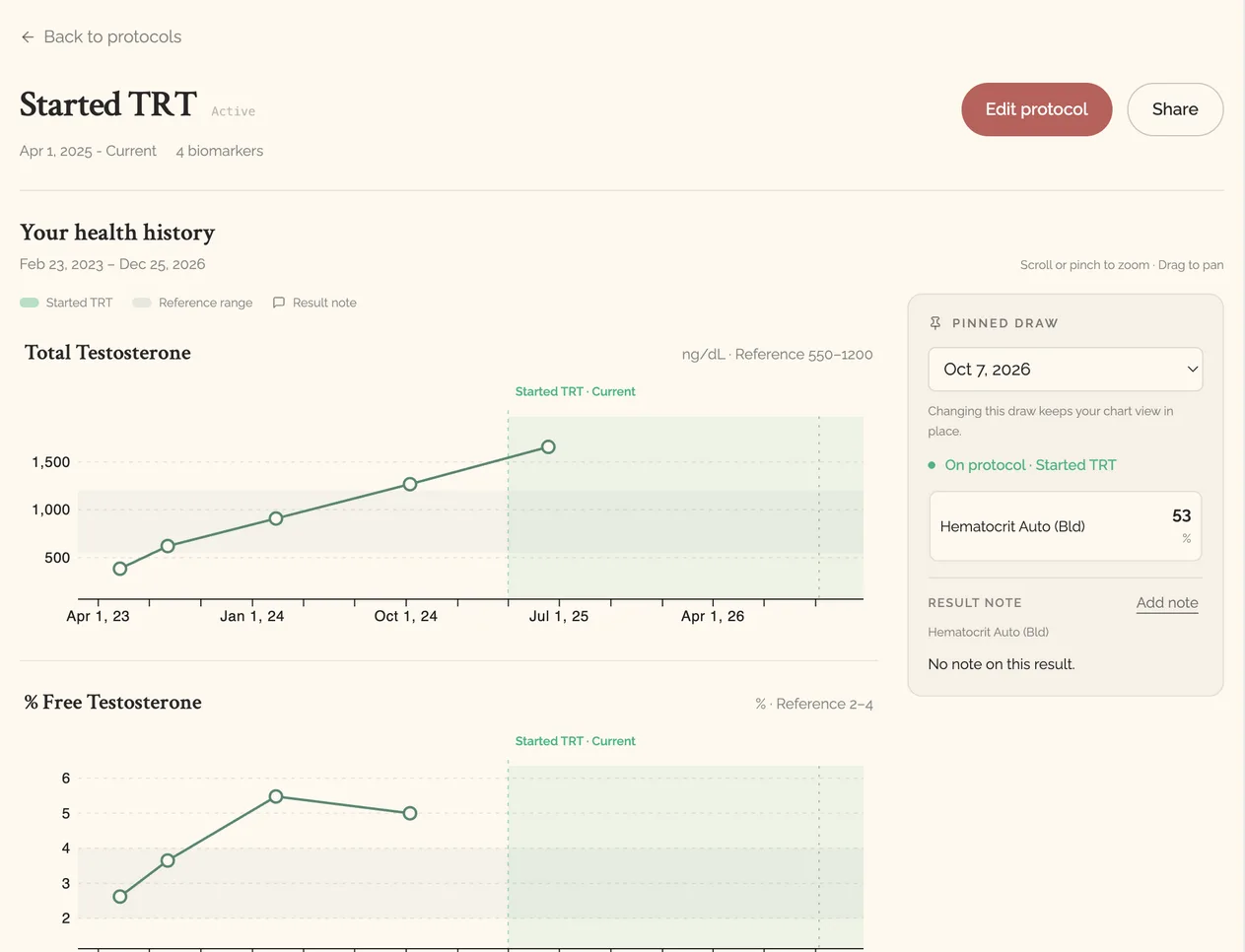
A "Started TRT" protocol shaded across every relevant chart.
With us, you can mark when you start or stop a medication, supplement, diet or training block, and every relevant chart shades that window. You can add notes to single results, save and reorder custom panels, and upload LabCorp and most Quest PDFs for free. Function adds a personalized action plan and a private AI chat, and lets you connect your results to outside AI tools such as ChatGPT and Claude.
Where Function Health is the better choice
- You want one broad baseline for a single yearly price. At $365, 100+ markers plus a mid-year retest is strong value, especially if you'd use the whole panel.
- You want a clinician's written summary and action items with every result.
- You want imaging or cancer screening add-ons. Function offers member pricing on MRI and CT, plus the Galleri test. We don't sell any of these.
- You want an at-home draw. Function offers one in select areas. We don't.
- You want a polished, all-in-one app with a personalized action plan built in.
Where Anabolic Insights is the better choice
- You don't want a membership. Order one test or one panel when you need it.
- You're tracking hormones. Single tests are cheap enough to recheck testosterone, estradiol and hematocrit on your provider's schedule.
- You want lab choice. Quest, LabCorp or BioReference, depending on the panel and your location.
- You want to see what a protocol did. Protocol overlays and notes show changes across every chart.
- You may want treatment. A licensed provider reviews every medication request. Medication is prescribed only if the provider decides it's appropriate. Our testosterone membership is $99 a month in 14 states.
Honest trade-offs: our turnaround of 7–14 days is slower than Function's first results, we don't offer at-home draws, and we don't bill insurance.
FAQs
How much does Function Health cost in 2026?
Function's pricing page lists $365 a year, or $1 a day. Its fine print calls this the first-year price and says membership renews at the then-current price. Add-on tests, at-home draws and imaging cost extra.
How many biomarkers does Function Health test?
Function says membership includes 100+ tests at your annual visit and 60+ tests 3–6 months later, which it markets as 160+ lab tests a year. Its public list shows 119 items included in membership, 62 of them tagged as tested twice a year.
Does Function Health retest testosterone at the mid-year visit?
Not according to its public test list. Testosterone, estradiol, SHBG and PSA are included in membership but aren't tagged as tested twice a year. Function says members can buy a re-test of any biomarker at a member-only price.
Is Function Health cheaper per marker than Anabolic Insights?
It's close. Function works out to about $2.02 to $2.28 per result if you use both draws, or $3.65 if you skip the retest. Our Quest panels range from $1.27 (Basic Panel) to $2.85 (Advanced Men's Panel+) per biomarker. Companies count biomarkers differently, so treat these numbers as rough.
Can I order a single blood test from Function Health without a membership?
No. Function sells add-on tests to members only. With Anabolic Insights you can order a single test, such as total testosterone for $14 at Quest, without a membership.
Which states does Function Health not serve?
Function's FAQ says it's available in 48 states, but not yet in Rhode Island, Hawaii or Puerto Rico. It also says testing in New York and New Jersey can cost more because of state rules.
How we compared
We reviewed Function Health's homepage, pricing, FAQ, how it works, what we test and imaging pages on October 11, 2026. Our prices and biomarker counts come from our live lab panels and individual test pages on the same day. Prices are before tax and promo codes, and either company can change them. Biomarker counts are as each company publishes them, except the "public list" row above, which is our own count of Function's What we test page.
Anabolic Insights publishes this page and has a financial interest in it. For other comparisons, read Anabolic Insights vs Marek Health, the best men's hormone blood panel, or does TRT raise ApoB.
References
- Sniderman AD, Thanassoulis G, Glavinovic T, et al. Apolipoprotein B particles and cardiovascular disease: a narrative review. JAMA Cardiol. 2019;4(12):1287–1295.
- Kronenberg F, Mora S, Stroes ESG, et al. Lipoprotein(a) in atherosclerotic cardiovascular disease and aortic stenosis: a European Atherosclerosis Society consensus statement. Eur Heart J. 2022;43(39):3925–3946.
- Bhasin S, Brito JP, Cunningham GR, et al. Testosterone therapy in men with hypogonadism: an Endocrine Society clinical practice guideline. J Clin Endocrinol Metab. 2018;103(5):1715–1744.
- Krogsbøll LT, Jørgensen KJ, Gøtzsche PC. General health checks in adults for reducing morbidity and mortality from disease. Cochrane Database Syst Rev. 2019;1:CD009009.
- Ganguli I, Simpkin AL, Lupo C, et al. Cascades of care after incidental findings in a US national survey of physicians. JAMA Netw Open. 2019;2(10):e1913325.